BiggerPockets.com just released a fascinating study on the nations residential real estate investors. The report shows solid activity and outlook amongst RE investors, here are a few highlights.

The survey found that 39 percent of active investors intend to increase their purchases over the next twelve months while 26 percent plan to buy as many in the year to come as they did in the past year. The 65 percent of investors who plan to buy the same amount or more in the next twelve months than they did in the past represents 4.5 million investors. Only 30 percent said they plan to buy fewer properties than they have in the past. Last year investors purchased 1.23 million homes, a 64.5 percent increase over 749,000 in 2010, according to the National Association of Realtors.

One Out of Eight American Adults is a Residential Real Estate Investor

Some 3 percent of American adults, or 7 million people, consider themselves to be real estate investors and they will be actively buying property with the next 12 months. An additional 9 percent own investment property but have no current plans to buy more. Thus, one out of eight, or 28.1 million, Americans either consider themselves residential real estate investors or own residential investment properties today.

The number of residential real estate investors today, according to the survey, is about the same as the number of Americans who own Roth IRAs (28.5 million) vi or the total number of money market fund shareholders (29 million). vii

Check out the full report on real estate investment trends.

{ 0 comments }

All Property Management just released a great infographic on the difference between managing your property yourself versus hiring a professional property manager.

Click here to enlarge

APM Infographic - DIY v Professional Management JPEG

Created by AllPropertyManagement.com

{ 0 comments }

Dave Borden recently mentioned a new tool designed to help prorate rent that is being offered on freerentalsite.com. I checked it out and it’s definitely the beefiest tool out there with lots of documentation to explain how to use it. The tool works great but it’s also really nice they explain how to use it in different situations that come up, for example when the rent due date is something other than the first of the month.

You can see the tool in action below. Tell me what you think about it.

{ 6 comments }

Our recent rental listing site report underscored the fact that Craigslist commands a strong presence in the search engines when potential tenants search for rental property. This, in addition to Craigslist’s large and loyal userbase, has arguably made it the most widely used “rental” site on the web.

Dave Dugdale, founder of Rentvine.com, recently posted a great interview with David Borden discussing the challenges and opportunities presented by Craigslist to the rental listing industry. (Click through to see the video.)

I see three important takeaways from this for owners of rental sites:

  1. User experience is key, and it really shouldn’t be difficult for a specialized site to do a better job. However, remember that Craigslist has two native advantages: tons of content, which users want to see, and a very simple, completely familiar interface that everyone already knows how to use. So, user experience should not be confused with simply having more features, your site also needs to be really intuitive.
  2. Rental scams still abound on Craigslist, and if a rental site does a better job of shutting down this activity, it could be an important selling point for users.
  3. Because Craigslist does not allow companies to competitively differentiate their listings, the shelf-life of a rental listing is very low. There is money to be made in allowing companies to compete.

{ 3 comments }

My last post compared the top rental sites in the U.S. based on their rankings in Google for competitive terms. But it left me with some questions. For example, does Rentals.com challenge Apartments.com for keywords like “apartments for rent”? So as a followup, I wanted to share some competitive keyword data that didn’t make it into the original post.

Some quick observations before getting into the data:

  • It is incredibly hard to dominate multiple categories, so sites are picking their battles carefully (see Apartments.com vs. Rentals.com).
  • Craigslist ranks perennially well in most categories – property managers take note.
  • Vacation rentals is a different ball game; the top 10 sites don’t perform well in this category.

Thanks to Google’s visualization API, I was able to put together the following interactive chart to allow you to mix and match the data for yourself. Here are some quick pointers:

  • Remember that #1 is the best rank, so in this case lower is better.
  • Select any combination of values, and the chart will change. Cool, huh?
  • Hold your mouse over elements of the chart to get more details.

Interactive Keyword Rankings Chart

Make head-to-head comparisons by selecting from the two lists below:

Top Rental Sites

Top Rental Keywords


Note: if you are a stakeholder in any of these companies and would like more data, contact me (360-718-9934). As always, suggestions and critiques are welcome.

{ 6 comments }

Search engine optimization is one of the things we’re passionate about, and periodically we like to do a deep dive and get a handle on what is happening in related industries. Recently we ran across Andrew Shotlands’s post “IYP SEO Rankings Report 2009” ranking the different internet yellow pages sites by their share of competitive search engine rankings, and decided to apply a similar methodology to see how the different rental sites stacked up against each other.

Since many of you property managers use these sites to publish your rental listings, we thought you’d be interested in seeing which of these sites perform the best for the most important rental keywords in the search engines.

In brief, here is the methodology we followed:

  • Identified the top 20 rental keywords using Google Suggest and the Adwords Keyword tool (see below)
  • Performed Google searches for these keywords in the top 20 U.S. cities, with personalization turned off (for a total of 400 geotargeted queries).
  • Each time a site appeared in the serps, we awarded it 1 point for each position, starting at the bottom. (On a page with 10 results, the first result got 10 points, the second 9 points, etc.)
  • Weighted each search by the U.S. monthly search volume for that keyword reported by Google.
  • Summed up the points for each domain to determine its final score.

So, in theory, this data should tell us which rental sites dominate the search engine rankings for the most important and competitive rental keywords.

And here are the results:

Top 25 Rental Sites by Search Engine Market Share

Top rental sites share of search engine rankings

Regional Rankings – Top 10 Rental Sites by City

Those were the nationwide rankings, but we noticed quite a bit of diversity in the rankings for each city. For example, regional websites like AllAustin.com frequently claimed top spots, even though they didn’t make the nationwide list. Property managers and investors operating in these markets might be interested in the following regional rankings:

Austin

  1. apartments.com
  2. allaustin.com
  3. apartmentguide.com
  4. rentals.com
  5. smallplanetguide.com
  6. austinapartmentstore.com
  7. rent.com
  8. statesman.com
  9. apartmentfinder.com
  10. rentalhomesplus.com

Baltimore

  1. apartments.com
  2. rent.com
  3. rentals.com
  4. sublet.com
  5. baltimoreapartments.com
  6. apartmentguide.com
  7. rentalhomesplus.com
  8. mynewplace.com
  9. apartmentratings.com
  10. craigslist.org

Charlotte

  1. apartments.com
  2. rentalhouses.com
  3. rent.com
  4. rentals.com
  5. apartmentfinder.com
  6. apartmentguide.com
  7. apartmentratings.com
  8. mynewplace.com
  9. craigslist.org
  10. 4rentcharlotte.com

Chicago

  1. apartments.com
  2. apartmentpeople.com
  3. chicagotribune.com
  4. chicagoapartmentfinders.com
  5. rent.com
  6. rentals.com
  7. apartmentguide.com
  8. mynewplace.com
  9. rentsmartchicago.com
  10. craigslist.org

Columbus

  1. apartments.com
  2. rentalhouses.com
  3. move.com
  4. rent.com
  5. rentals.com
  6. apartmentguide.com
  7. apartmentfinder.com
  8. craigslist.org
  9. columbusbestrentals.com
  10. columbusrent.com

Dallas

  1. apartments.com
  2. rent.com
  3. rentalhouses.com
  4. apartmentguide.com
  5. apartmentfinder.com
  6. rentals.com
  7. rentalhomesplus.com
  8. apartmentratings.com
  9. forrent.com
  10. move.com

Detroit

  1. apartments.com
  2. craigslist.org
  3. rentals.com
  4. rent.com
  5. move.com
  6. mynewplace.com
  7. apartmentratings.com
  8. rentalhomesplus.com
  9. sublet.com
  10. rentlinx.com

Fort Worth

  1. rentals.com
  2. apartments.com
  3. apartmentratings.com
  4. rent.com
  5. craigslist.org
  6. rentalhouses.com
  7. move.com
  8. rentalhomesplus.com
  9. apartmentguide.com
  10. apartmentwiz.com

Houston

  1. apartments.com
  2. rentals.com
  3. rent.com
  4. houston1apartments.com
  5. apartmentguide.com
  6. har.com
  7. apartmentfinder.com
  8. houstonapartments.com
  9. rentalhomesplus.com
  10. apartmentratings.com

Indianapolis

  1. apartmentguide.com
  2. apartments.com
  3. rent.com
  4. rentalhouses.com
  5. rentals.com
  6. mynewplace.com
  7. apartmentratings.com
  8. dorfmanpropertymanagement.com
  9. placetoliverentals.com
  10. craigslist.org

Jacksonville

  1. rentals.com
  2. apartments.com
  3. rent.com
  4. mynewplace.com
  5. rentalhouses.com
  6. apartmentguide.com
  7. jaxguide.com
  8. firstcoastrentalads.com
  9. apartmentratings.com
  10. rentalhomesplus.com

Los Angeles

  1. apartments.com
  2. latimes.com
  3. craigslist.org
  4. apartmentguide.com
  5. rent.com
  6. westsiderentals.com
  7. 4rentinla.com
  8. forrent.com
  9. apartmentfinder.com
  10. rentals.com

Also see our directory of Los Angeles property management companies.

Memphis

  1. rent.com
  2. apartments.com
  3. rentals.com
  4. apartmentguide.com
  5. rentalhouses.com
  6. apartmentratings.com
  7. craigslist.org
  8. apartmentfinder.com
  9. forrent.com
  10. move.com

New York

  1. apartments.com
  2. citi-habitats.com
  3. rentals.com
  4. nycdwellers.com
  5. rent.com
  6. markdavidny.com
  7. elikaassociates.com
  8. rentalhouses.com
  9. nytimes.com
  10. anchornyc.com

Philadelphia

  1. apartments.com
  2. craigslist.org
  3. apartmentguide.com
  4. sublet.com
  5. 4wallsinphilly.com
  6. rentals.com
  7. phillyapartmentco.com
  8. rentinphilly.com
  9. reinholdresidential.com
  10. apartmentratings.com

Phoenix

  1. apartmentguide.com
  2. apartments.com
  3. rentals.com
  4. azcentral.com
  5. rent.com
  6. rentvine.com
  7. rentalhouses.com
  8. apartmentratings.com
  9. mynewplace.com
  10. craigslist.org

San Antonio

  1. apartments.com
  2. rentals.com
  3. mysanantonio.com
  4. apartmentratings.com
  5. rent.com
  6. apartmentguide.com
  7. forrent.com
  8. rentalhomesplus.com
  9. apartmentfinder.com
  10. sanantonioapartmentstore.com

San Diego

  1. forrent.com
  2. apartments.com
  3. craigslist.org
  4. rent.com
  5. rentals.com
  6. signonsandiego.com
  7. apartmentguide.com
  8. sandiegoapartments.com
  9. apartmentratings.com
  10. move.com

San Francisco

  1. craigslist.org
  2. apartments.com
  3. rentalguide.com
  4. rentinsanfrancisco.com
  5. mynewplace.com
  6. apartmentratings.com
  7. sfgate.com
  8. apartmentfinder.com
  9. apartmentguide.com
  10. rentals.com

Also see our directory of San Francisco property management companies.

San Jose

  1. apartments.com
  2. rent.com
  3. rentals.com
  4. mynewplace.com
  5. apartmentratings.com
  6. sublet.com
  7. apartmentguide.com
  8. move.com
  9. craigslist.org
  10. house.info

Anticipated questions

  • Why did you only use Google rankings? We realized that results would vary by search engine, but collecting data for multiple search engines would have been tricky, and given that Google still commands 65.5% of the market, they were the logical first pick.
  • Why only the top 20 keywords? From a data collection standpoint, this was the only approach that made sense. There are simply too many “long tail” keywords, and we weren’t confident that we could develop a representative sample set. So we decided to focus on performance for the highest traffic “head” terms.
  • What about site traffic? It is hard to make an apples-to-apples comparison based on traffic numbers. Some sites get a lot of traffic from non-organic sources, and some cover a wide range of topics, like Craigslist.org, so Compete.com numbers aren’t very helpful when trying to determine search engine dominance.
  • Were the searches conducted from an IP address located in the searched city? Nope, that would have been helpful but our branch offices in these 20 cities were all tied up while we performing the research ;-) , so to quote Andrew Shotland on this point “c’est la seach”.

If you have any other specific questions about our methodology or the data we collected, let us know in the comments or via email.

Footnotes

Here are the keywords we used, with search volume data from Google Adwords:

Keyword Search Share US Monthly Searches
apartments 28% 37,200,000
rentals 23% 30,400,000
apartment 10% 13,600,000
apartments for rent 6% 7,480,000
vacation rentals 6% 7,480,000
homes for rent 5% 6,120,000
homes rent 5% 6,120,000
rent houses 3% 4,090,000
apartments rent 3% 4,090,000
houses for rent 3% 3,350,000
vacation rental 1% 1,830,000
apartment rental 1% 1,500,000
rent house 1% 1,500,000
apartment rent 1% 1,220,000
rental homes 1% 1,220,000
house for rent 1% 1,000,000
apartment rentals 1% 1,000,000
rental home 1% 1,000,000
house rentals 1% 1,000,000
rental house 1% 823,000

So, that’s it. Thoughts?

Update: There’s more! See our followup post.

{ 17 comments }

This is a follow up to our survey of almost 3,000 reviews of property management companies on Yelp and Yahoo Local.

Why is it that management companies seem to get such a bad rap in online reviews? It would be easy to dismiss these review sites as being platforms for libel by disgruntled people with an axe to grind, but the reality is rating sites are a useful tool that are widely used by consumers.

61% of people rely on user reviews for product information or research before a buying decision is made. (Razorfish, 2008)

Knowing that consumers use online rating and review sites for everything from restaurants to doctors to apartments, we felt compelled to better understand why our research showed property managers were on average getting 30% lower ratings than the average for all other industries.

In fact if you’re looking to be entertained by passionately negative reviews, the property management industry pretty much takes the cake:
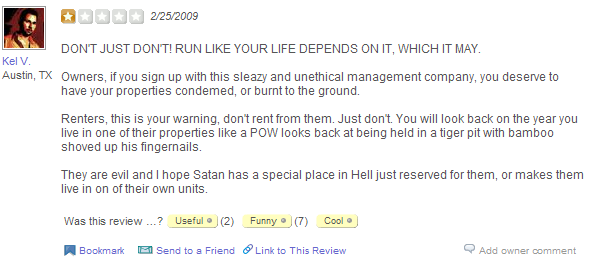
Unfortunately property management can be a thankless job, where tenants are hyper-sensitive to mistakes and often resent the enforcer aspect of the management company’ role. Obviously, not all tenant/property manager relations are like this, but as our research and the ubiquity of these glowing (as in firebrand) reviews show, it isn’t uncommon either.

Here’s my breakdown of what makes this industry unique in garnering so much negativity.

Spoiler alert: You’re going to be disappointed if you’re wanting me to place all the blame squarely on tenants or the management company.

The single biggest reason for low reviews from tenants is that the management company acts as an enforcer to uphold the interests of the landlord. This tension lies behind about 75% of the negative reviews we surveyed. Granted, the complaints tend to deal with surface issues, but this enforcement dynamic in the relationship is a root cause for bad blood between tenants and management companies. In this respect, property management has something in common with professions like police officer, tax collector, prison guard, prosecutor, repo man, etc., which all have significant enforcement roles and suffer from the same negative sentiment.

This negative perception of the MC as an enforcer is amplified when it is the only frame of reference tenants have. Because much of rental housing is treated like a commodity (renters shop primarily on price) margins are low, leaving little room for the kinds of extra services that create a positive impression and relationship. This means that tenant interaction is limited to paying bills, trying to get broken things fixed, or reporting other problems, which isn’t exactly the foundation for a glowing relationship.

Together, these factors have a negative impact on both tenant AND management behavior making it easier to find fault than solutions. Constructive dialogue is quickly replaced with a willingness to jump to conclusions and demonize the actions of the other party. Once an “us against them” mentality takes hold, it isn’t long before the tenant views himself as the little guy “fighting the man” in a crusade against landlord tyranny. The flip-side is the property manager who feels totally unappreciated and is tired of getting dumped on resulting in cold or overly heavy handed in dealings with tenants.

All these emotions are amplified by the fact that people’s homes are an important part of their security causing strong reactions to any perceived threat.

Again, my goal is not to label one side as being primarily responsible. We can all recognize that there are bad tenants that don’t pay rent, as well as negligent management companies that fail in their responsibilities. My point is that the inherent dynamics of the tenant/manager relationship lend themselves to strife.

Obviously I’m not the first person to recognize this and many management companies have well thought out tenant retention programs designed to maintain strong positive relationships and keep tenants happy. Check out Mike Brewer and Heather Blume for cutting edge strategies.

Is it fair?

No, but does that really matter?

Clearly, tenants are not in a position to tell owners who they should hire, and yet their reviews can affect the reputation of the management companies and influence client perceptions.  While this can be a bitter pill to swallow, it’s imperative that you embrace the fact that you’re not in control of what is said about you online.

As consumers are empowered by review sites and social networks to share their experiences, businesses of all types are becoming acutely aware of the need for online reputation management.

Who is talking about you, what are they saying, and how should you respond?  We’ll cover this and more in next week’s overview of reputation management for property management companies.

How are you dealing with tenants and owners talking about you online?

{ 10 comments }

The following word clouds are comprised of actual words and phrases from the 3,000 reviews we surveyed.

*The above word clouds are comprised of actual words and phrases from the 3,000 reviews we surveyed.

In my last article we covered some of the results from our survey of almost 3,000 reviews of property management companies on Yelp and Yahoo Local (read it first). We found that while there was a mix of tenants, owners, contractors, and realtors leaving reviews, the vast majority of the reviews were left by tenants. This makes sense if for no other reason than the fact that there are far more tenants than any of the other groups.

The fact that the reviews are highly polarized (love or hate) was easy to pick out, but beyond that there were a number of other common themes that came up over and over again. Here were the key issues that for tenants and landlords:

Landlords

Common Complaints

  • Delayed reaction time to phone calls and e-mails
  • Failure to promptly send out checks
  • Excessive and/or unexpected fees (especially maintenance fees)
  • Incompetent maintenance staff or contractors (slow, shoddy, overpriced work)
  • Took too long to find a tenant
  • Placing low quality tenants

Common Praise

  • Quick placement of tenant
  • Placement of quality tenants
  • Made the landlording process easy
  • Professional demeanor and rapport
  • Knowledgeable staff, understand the law and finer points of dealing with tenants

Tenants

Common Complaints

  • Long-standing maintenance requests – Tenant feels ignored or like they’re being passed from person to person in an revolving door of personnel and empty promises and excuses.
  • Run down dwelling – Everything from bugs to water spots. The worse the circumstances the more upset they are and the more explosive and colorful the review.
  • Rejection of maintenance or upgrade requests
  • Hard to get ahold of management. Took multiple phone calls and emails.
  • Failure to return all or a portion of the security deposit.
  • Rent increases – too often or a sharp jump.
  • Unfair enforcement of lease violations, fees and evictions.
  • Poor interpersonal skills – Property manager was rude, condescending etc.
  • Bait & switch – Showing a unit different than the actual unit issued, making false or misleading promises or move-in incentives, etc.

Common Praise

  • Friendly caring staff
  • Property manager was understanding and genuinely wanted to help tenant
  • Quick response to maintenance requests

It likely comes as no surprise to property managers that the list of complaints is longer than praises from tenants. The reasons for this are important as tenant reviews shape the overall atmosphere for online reviews of management companies. I’ll be covering this soon in a post titled “Why people love to hate their property management company”.

Want to beat me to the punch and provide your own explanation of what influences the online reviews we see in this industry? Let me know in the comments.

{ 0 comments }

Over the last five years customer rating and reviews sites have exploded onto the scene as a major force in the buying and decision making process for consumers. From sites built around reviews like Yelp, to internet yellow pages (IYP’s) which have incorporated them as an important feature, online reviews abound and consumers are using them to decide where to buy.

Much has been said about the good and evil of rating & review sites which often struggle to balance the interests of the businesses being reviewed, the users leaving the reviews, and their own financial interests. No matter how you feel about these sites it’s clear they are here to stay and affecting the businesses being reviewed. It’s not uncommon to see sites like Yelp ranking on the first page for searches on company names, or to see reviews from multiple sites aggregated in the search results of Google Maps.

Property management ratings on Yahoo Local

Every industry has a unique set of dynamics that influence the average customer sentiment, and while we had a pretty strong hunch of how property managers fare on these sites, we decided to do the research required to get some more concrete data.

We decided to use Yahoo Local as our source for reviews because of it’s size and reputation as one of the largest, longest standing sites in this space. We surveyed their reviews for property management companies in the following cities:

  • Austin
  • Atlanta
  • Boston
  • Dallas
  • Denver
  • Indianapolis
  • New York
  • Orlando
  • Phoenix

Of the +15,000 property management companies listed in these cities, roughly 7% had reviews. These 1,022 companies had a total of 2,118 reviews which we used to generate the following charts:

Yahoo Local’s ratings and reviews for property management companies

Breakout of property management company ratings on Yahoo LocalBreakout of property management company reviews on Yahoo Local

*Note: Reviewers can only rate with whole stars but average company ratings are calculated using half stars.

As you can see there is a very strong polarization with 90% of all reviews being either 1 or 5 stars. The average company rating further validates this strong trend of highly polarized sentiment toward property management companies.

Because of the anecdotal research we had done in the past, we were prepared to find polarization, but we were still surprised to see just how strong it was.

The stark nature of these results piqued our interest in understanding how they would compare against another review site, as well as how these ratings for property management companies would compare to other industries.

Comparing Yahoo Local to Yelp

We chose to look at Yelp because they are a well known platform built around online reviews and claim to have a filtering mechanism that weeds out fake/fraudulent user reviews. We wanted to see how this would impact the reviews compared to Yahoo Local which is much less aggressive in filtering their review results. In addition, Yelp has provided benchmarks for the average distribution of reviews on their platform across all industries and business types.

We looked at the ratings for property management companies in the same 13 cities which yielded 840 reviews from 208 companies. While the average number of reviews per company is considerably higher on Yelp (4 per company on Yelp vs 2 per company on Yahoo Local), the overall number of property management companies reviewed was about a fifth of what was on Yahoo Local in the same geography. This is at least in part because of the more aggressive review filtering mechanism Yelp uses.

Yelp’s ratings and reviews for property management companies

Breakout of property management company ratings on YelpBreakout of property management company reviews on Yelp

*Note: Reviewers can only rate with whole stars but average company ratings are calculated using half stars.

The reviews on Yelp were more balanced than Yahoo Local, but the strong polarization towards 1 and 5 star reviews is still clear. It becomes even more clear when we compare the reviews we collected from Yahoo Local and Yelp specifically for property management companies vs the reviews from Yelp across all industries and business types.

Comparison of review counts for Yelp sitewide with property management company reviews

Average # of stars given:

  • Yahoo Local (Property management companies only)
    • 2.2 stars
  • Yelp (Property management companies only)
    • 2.7 stars
  • Yelp  (Across all industries and business types)
    • 3.8 stars
  • BazaarVoice Rating Service (Across all industries and business types)
    • 4.3 stars

Clearly online reviews for property management companies are far more polarized than other industries. Tomorrow we will be posting a follow up post on some more of what we found in surveying these reviews as well as our thoughts on what specific industry dynamics cause this polarization.

What do you think about these results?

{ 9 comments }

  1. There are no facts inside the building. The only person who knows about your customer… is your customer. If you really want to know what they think then go talk to them and start asking broad questions about their needs, not if they like your product/service.
  2. Remember Parkinson’s Law: Work expands so as to fill the time available for its completion. Force yourself to meet deadlines. This requires getting better at making realistic time projections.
  3. Ruthlessly apply the 80/20 rule. Measure, to find what works really well and focus your time there. Beware, distractions abound.
  4. Avoid information overload. Limit your consumption to what you can actually use at this present time.
  5. Never underestimate your ability to delude yourself. Fight this with testing, metrics, peer review and mentorship.
  6. Business plans always fail. Learn to pivot. The goal is to get to plan B.
  7. Don’t put your life on hold to start a business. It doesn’t work. Make sure you are engaging in sustainable habits from day one.
  8. Work on what you’re passionate about. Don’t build a business around something you’re not passionate about. A day will come when your regret it and it starts to suck the life out of you.
  9. On the web, if there’s a person, product or process that sounds to good to be true. It is. Lock your wallet and run. People selling shortcuts are almost always selling nothing for something (This is especially true with internet marketing). Don’t believe me? That’s how scammers stay in business.

{ 4 comments }